mRNA melanoma vaccine plus Keytruda cut recurrence risk by 42% in phase 3
In a randomized trial of more than 1,100 people after high-risk melanoma surgery, 82% receiving the vaccine combination were recurrence-free at two years, versus 70% on Keytruda alone.
, updated . 2-minute read.
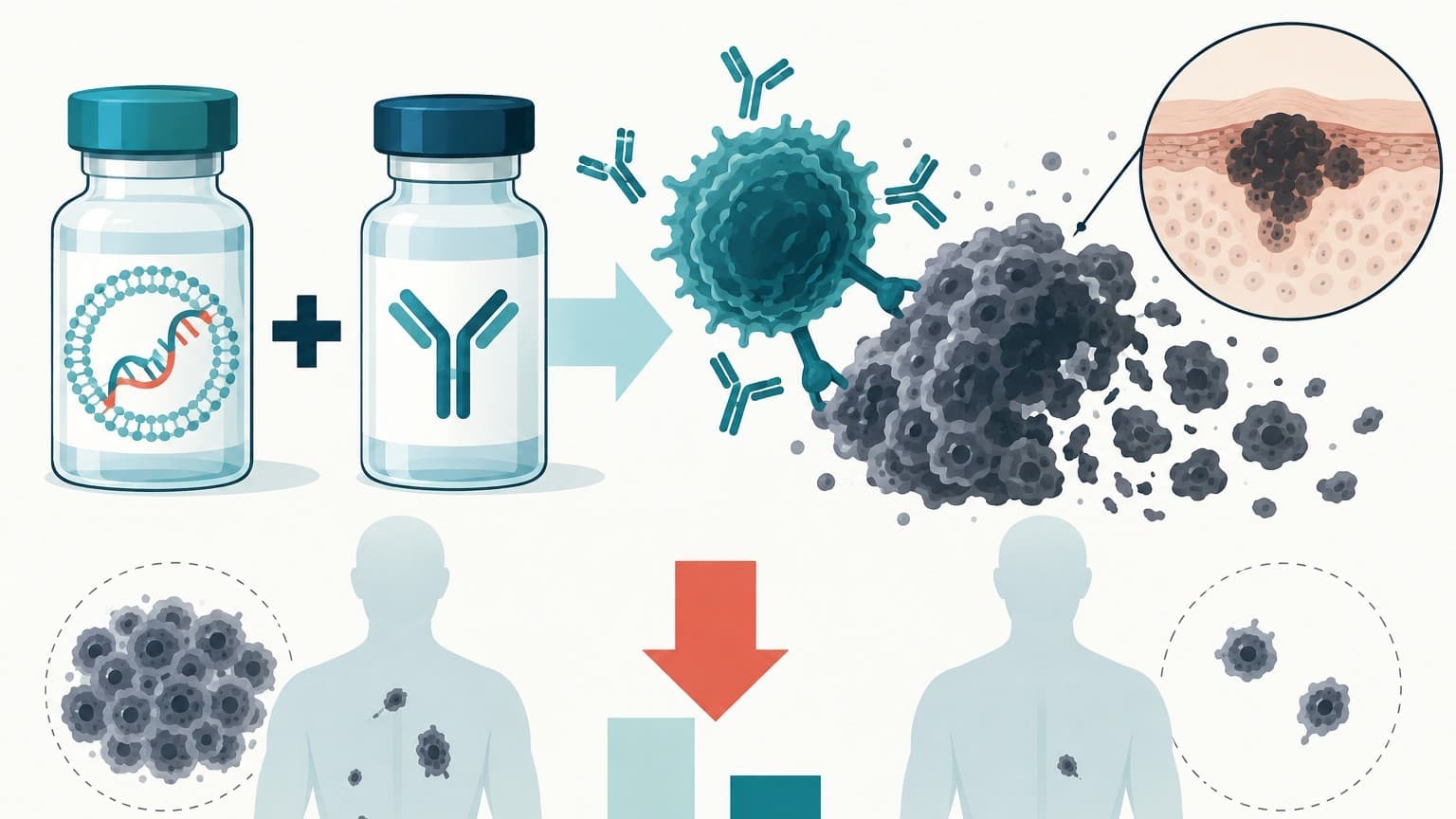
The phase 3 INTerpath-001 trial enrolled more than 1,100 patients whose high-risk melanoma had been surgically removed and randomly assigned them to two study arms. Everyone received the standard post-surgery treatment, Merck's Keytruda; those in the experimental group also received Moderna's personalized mRNA vaccine intismeran autogene, also called mRNA-4157 or V940, and the comparison group received placebo.
At a median follow-up of two years, the vaccine-plus-Keytruda group had a 42 per cent lower risk of melanoma recurrence or death than those on Keytruda alone, according to data the companies released on Thursday, October 22.
CBC reported that at two years, 82 per cent of patients in the vaccine group were alive without a recurrence, compared with 70 per cent in the Keytruda-alone group. Hussein Tawbi, a melanoma researcher at MD Anderson Cancer Center and one of the trial investigators, said in comments to Reuters that the result was highly statistically significant and not due to chance.
CBC reported that intismeran uses the same Nobel Prize-winning mRNA technology behind COVID-19 vaccines. The vaccine is custom-brewed for each patient from mutations unique to that patient's tumor; patients received nine doses three weeks apart to train the immune system to attack those neoantigens. Tawbi said the main side effects were injection-site soreness, tiredness and other reactions commonly seen with mRNA vaccination.
CBC reported that Moderna's president, Stephen Hoge, said a company-owned cancer vaccine manufacturing site in Massachusetts is supplying doses for thousands of participants across multiple international studies, and that the whole process, starting with analyzing the tumor genetics to come up with a recipe, can take roughly six weeks, sometimes more.
Coinpedia reported that the combination cut the chance of distant metastasis or death by 38 per cent relative to Keytruda alone, and that overall survival figures are not mature, with only an early favorable trend.
CBC reported that the detailed results had been scheduled for presentation Saturday at a European Society for Medical Oncology meeting in Madrid, but after some data were leaked online late Thursday, the companies released the full dataset ahead of the scientific presentation. Merck and Moderna said they are discussing next steps with regulators toward seeking approval.
CBC also reported that Moderna shares closed 18 per cent lower on Thursday after the data were leaked, while Merck shares fell about 1.8 per cent by the close. CBC, citing Reuters, reported that before the meeting, Wall Street analysts had set a higher bar for the combination's effect on recurrence risk than the 42 per cent shown.
Investigators are continuing to follow participants for later outcomes. The data do not yet show whether the combination improves overall survival, and the companies have not publicly discussed what the personalized vaccine might cost.
Update, October 24, 2026
The trial’s two-year recurrence-free survival was 82.2 per cent with the vaccine plus pembrolizumab versus 70 per cent for pembrolizumab alone, an absolute difference of 12.2 percentage points; Ynet calculated that roughly one additional patient remained recurrence-free for every eight treated. The Phase 3 INTerpath-001 trial enrolled exactly 1,137 patients with stage IIB to IV melanoma whose tumours had been completely removed. The personalised vaccine encodes up to 34 tumour-specific neoantigens.
A prespecified analysis after the roughly six-month vaccination course found a 58 per cent relative reduction in the risk of recurrence or death. Treatment-related adverse events occurred in 95.8 per cent of the vaccine group and 90 per cent of the Keytruda-alone group; grade 3–5 treatment-related events occurred in 14.2 per cent and 13.4 per cent, with fever, fatigue, chills and injection-site pain among common side effects.
Moderna is targeting a possible US launch in 2027, according to Ynet, and the FDA has not previously evaluated a personalised cancer vaccine of this type; Karen Knudsen, CEO of the Parker Institute for Cancer Immunotherapy, told The Washington Post that this “is going to be new territory for the FDA”. Science Media Centre España said the personalised manufacturing process is “predictably costly” and will require cost-effectiveness assessments, and that longer follow-up is needed to confirm duration of benefit and impact on overall survival.
Sources
- Merck/Moderna's Melanoma Combination Therapy Delivers Promising Phase 3 Trial Results, Seeking Alpha
- A novel mRNA cancer vaccine helps cut the chances of melanoma tumor recurrence in major study, CBC
- Why Did Moderna Stock Crash 17% Despite Positive Cancer Vaccine Results?, Coinpedia Fintech News
- The results of the personalised melanoma vaccine will be presented at the european congress of medical oncology, SMC España
- Moderna's melanoma vaccine succeeds in major trial. So why did its stock plunge?, ynetglobal
Corrections. Report an error to corrections@clinicalobserver.com. Read our corrections policy.