B7-H3 ADCs extend survival in relapsed small-cell lung cancer
Phase 3 trials of risvutatug rezetecan and tambotatug pelitecan cut the risk of death by 54% versus topotecan, but both studies were conducted only in China.
. 4-minute read.
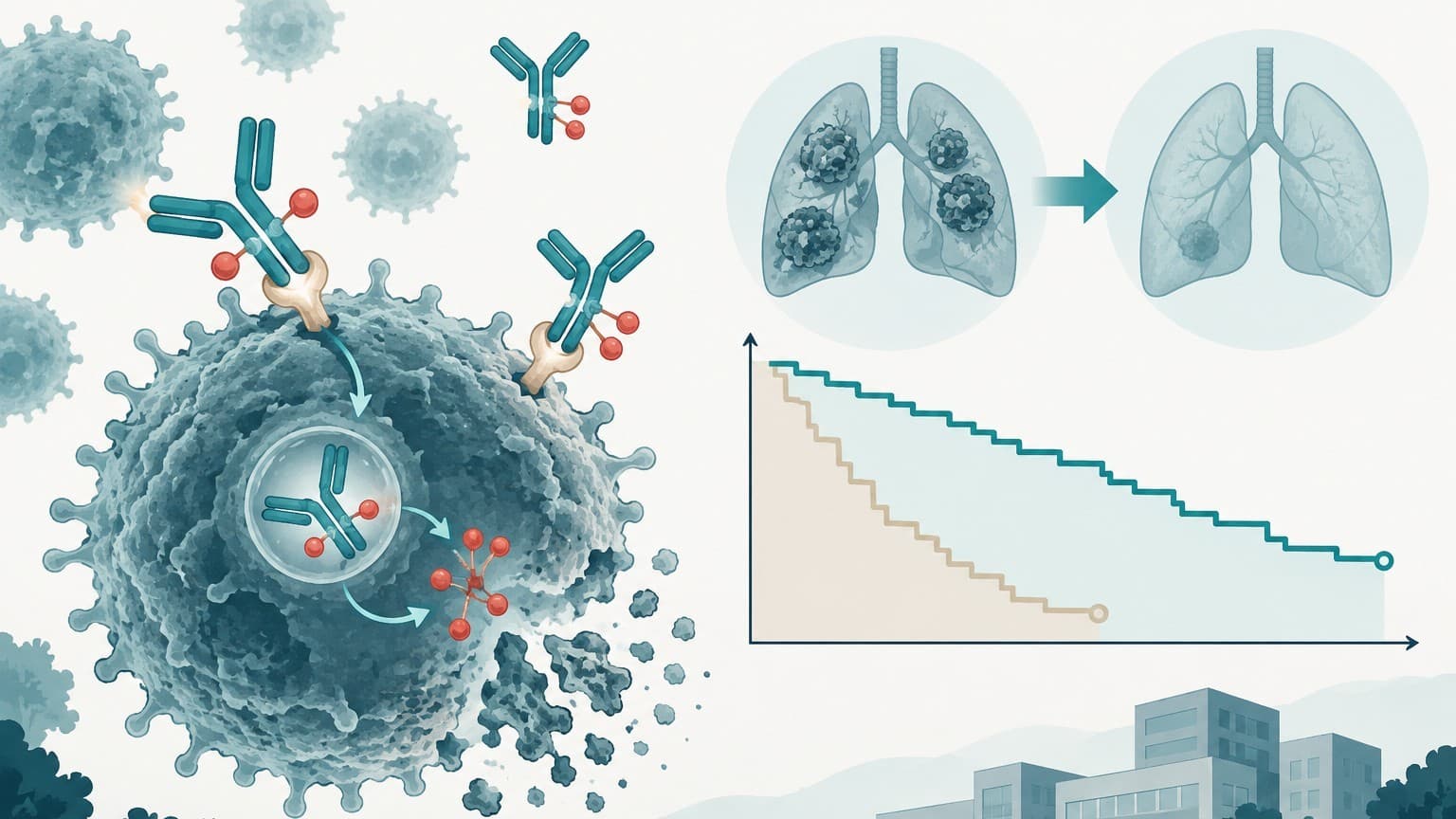
Two B7-H3-directed antibody-drug conjugates extended overall survival in phase 3 trials in relapsed small-cell lung cancer, investigators reported at the World Conference on Lung Cancer on September 13, 2026. In the open-label TAISHAN-302 study, 451 patients in China were randomized to tambotatug pelitecan or topotecan. Treatment with tambotatug pelitecan led to median overall survival of 13.3 months, compared with 9.4 months for topotecan (hazard ratio, 0.46; 95% confidence interval, 0.35 to 0.62; P < 0.0001), and 59.1% of patients responded, versus 9.7% with topotecan. The ARTEMIS-008 study randomized 461 patients to risvutatug rezetecan or topotecan. Patients receiving risvutatug rezetecan had median overall survival of 18.5 months, versus 10.3 months in the topotecan group (hazard ratio, 0.46; 95% confidence interval, 0.35 to 0.62), and 58.3% responded, compared with 12.6% on topotecan. Both trials also showed longer progression-free survival: median PFS was 7.4 months with tambotatug pelitecan versus 2.8 months with topotecan, and 7.2 months with risvutatug rezetecan versus 3.0 months.
The two ADCs differ in construction. Risvutatug rezetecan couples an anti-B7-H3 antibody to a topoisomerase I inhibitor, while tambotatug pelitecan uses MediLink's TMALIN platform, which releases a camptothecin-based payload inside cancer cells and in the tumor microenvironment.
Earlier late-stage ADC readouts in 2026
The breast cancer field had its own advance months earlier. The FDA approved fam-trastuzumab deruxtecan-nxki (Enhertu) plus pertuzumab on December 15, 2025, as first-line therapy for HER2-positive breast cancer that is unresectable or metastatic, based on the phase 3 DESTINY-Breast09 trial. In that trial, T-DXd plus pertuzumab produced a median progression-free survival of 40.7 months versus 26.9 months with taxane, trastuzumab and pertuzumab (HR 0.56; P<.0001). At the 2026 ASCO Annual Meeting, a subanalysis showed that 52.8% of patients had a complete or deep partial response, and about 80% of those patients were free from progression or death at 2 years.
On August 28, 2026, GSK and Hansoh Pharma announced the first phase 3 efficacy for an ADC in osteosarcoma. The drug, called Rislez, improved progression-free survival statistically significantly over standard chemotherapy in a Chinese phase 3 study of patients whose disease had progressed after at least two lines of therapy, but detailed medians, hazard ratios and p-values were not disclosed. In June 2026, the FDA designated SOTIO's LRRC15-directed ADC SOT106 as an orphan drug and fast track candidate for osteosarcoma; SOTIO plans to begin first-in-human dosing within 2026 using biomarker-based selection of patients with at least 1% LRRC15-positive tumor cells.
A separate DLL3-directed ADC, IDE849 from IDEAYA Biosciences, advanced after an FDA Type C meeting on August 31, 2026 supported a phase 3 design in extensive-stage SCLC for patients previously treated with tarlatamab. The planned 400-patient trial will use overall response rate for accelerated approval and overall survival for full approval.
What the SCLC results do and do not show
At WCLC, invited discussant Anne Chiang described the two B7-H3 ADCs as "great options for our patients." She added that within two to five years, ADCs are likely to become the standard second-line therapy for relapsed SCLC and could displace chemotherapy as initial treatment. However, both SCLC trials were conducted only in China. Fierce Biotech reported that GSK's global oncology R&D head cited consistent Chinese and global data on another ADC to support confidence that the results will translate, and that a global phase 3 trial of risvutatug rezetecan in relapsed SCLC is already under way, with pivotal data expected in 2027.
Safety profiles differ. In the Chinese phase 3, risvutatug rezetecan had a grade 3 or higher treatment-related adverse event rate of 60.9% versus 78.2% with topotecan, and interstitial lung disease or pneumonitis occurred in 11.7% versus 1.9%. Tambotatug pelitecan had a 55.4% rate of grade 3 or higher adverse events versus 77.9%, with ILD/pneumonitis in 4.9% versus 1.4%. No grade 4 or 5 ILD events occurred in the Hansoh phase 3 trial of risvutatug rezetecan, whereas the phase 2 trial of ifinatamab deruxtecan from Daiichi Sankyo and Merck recorded two treatment-related deaths from ILD or pneumonitis.
Competitors include ifinatamab deruxtecan, a B7-H3 ADC from Daiichi Sankyo and Merck, which received FDA priority review in April 2026 for adults with extensive-stage SCLC that had progressed after platinum-based chemotherapy, with a decision due in October 2026. Amgen's DLL3-targeted T-cell engager tarlatamab (Imdelltra) has a phase 3 median overall survival of 13.6 months versus 8.3 months with chemotherapy in the same setting and is approved in the U.S. and Europe.
Implications for development
The SCLC data show that Chinese-licensed ADCs can produce phase 3 survival benefits, but the next challenge is to reproduce those benefits globally. GSK licensed risvutatug rezetecan from Hansoh in 2023 for $185 million upfront, and Roche licensed tambotatug pelitecan from MediLink in January 2026 for $570 million upfront. GSK has begun a global phase 3 study of risvutatug rezetecan, and Roche plans to start global phase 3 testing of tambotatug pelitecan. The next question is whether the 54% reduction in the risk of death observed in China will be reproduced in global trials.
Sources
- Secondary End Point ADC Data Add Context to HER2+ and Triple-Negative Breast Cancer Care, OncLive
- Osteosarcoma ADC breakthrough sparks race as SOT106 readies trials and deals - CHOSUNBIZ, CHOSUNBIZ
- FDA Type C Meeting Supports Phase 3 Design for DLL3-Targeted ADC in ES-SCLC, Targeted Oncology - Immunotherapy, Biomarkers, and Cancer Pathways
- GSK’s Hansoh-partnered ADC lays down marker for lung cancer scrap with Merck, Fierce Biotech
- Significant Survival Boost With Novel ADCs in Relapsed Small-Cell Lung Cancer, MedpageToday
- GSK and Roche Chinese ADC bets deliver positive phase 3 data in SCLC, European Biotechnology Magazine
Corrections. Report an error to corrections@clinicalobserver.com. Read our corrections policy.