Otsuka Reports Phase 3 Data Showing VOYXACT Cut Kidney Decline Risk in IgA Nephropathy
Final VISIONARY results presented at ASN show a 97.1% lower hazard of kidney function decline or failure versus placebo over two years.
, updated . 2-minute read.
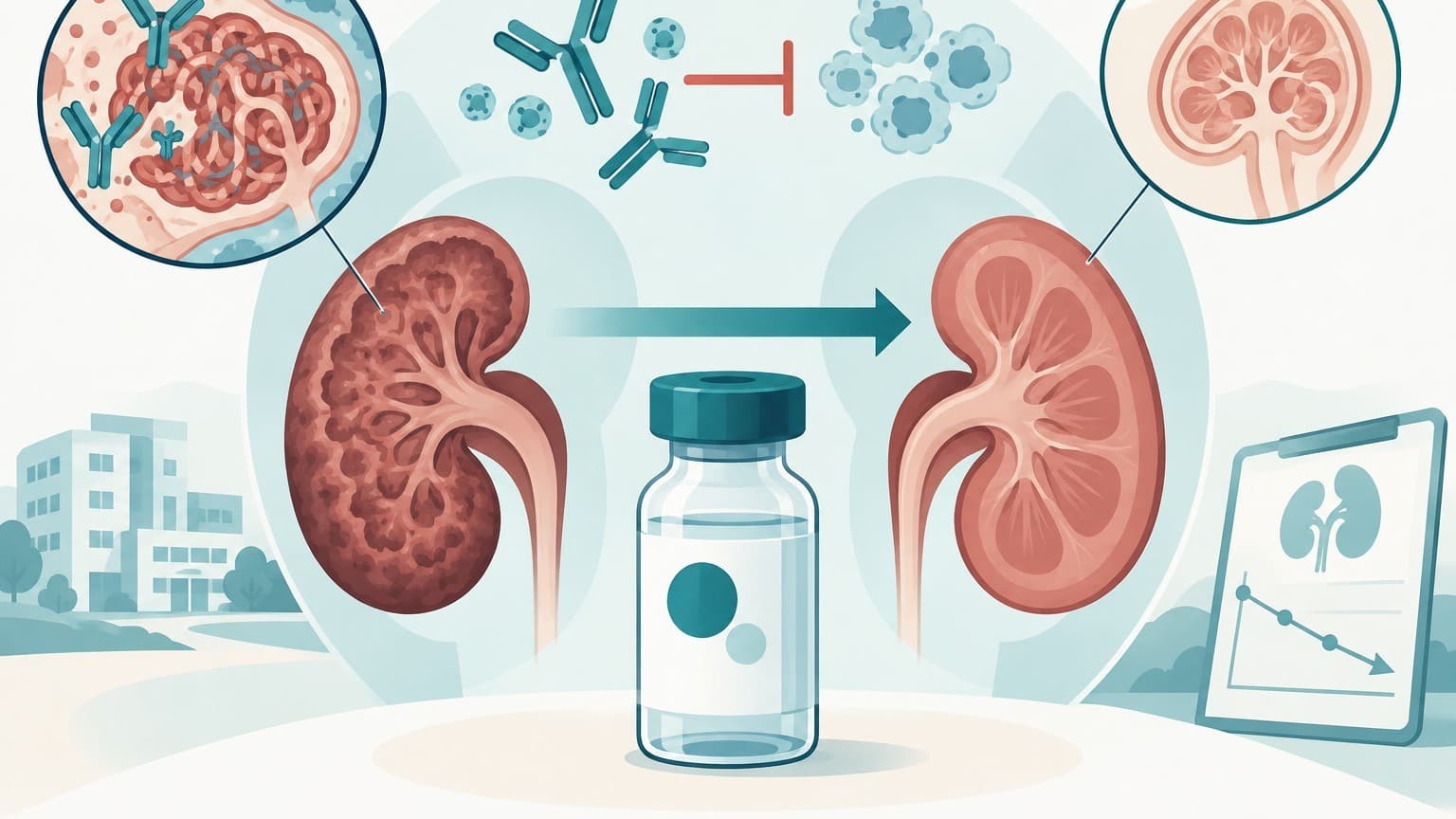
Otsuka’s VOYXACT (sibeprenlimab-szsi), which the U.S. FDA granted accelerated approval in November 2025 to reduce proteinuria in adults with primary IgA nephropathy at risk for disease progression, stabilized kidney function in final Phase 3 VISIONARY results presented at ASN Kidney Week 2026. The findings were published simultaneously in The New England Journal of Medicine.
The Phase 3 VISIONARY trial was a randomized, double-blind, placebo-controlled study that enrolled 510 adults with primary IgA nephropathy at risk for disease progression. Its primary efficacy endpoint was change in 24-hour urine protein-to-creatinine ratio from baseline to nine months. After two years, a composite kidney outcome of sustained kidney function decline or kidney failure occurred in 1 of 259 patients receiving VOYXACT (0.4%) and 28 of 251 patients receiving placebo (11.2%). Otsuka calculated that this represents a 97.1% lower hazard with VOYXACT.
Individual parts of the composite endpoint also favored the drug. One patient taking VOYXACT had a sustained eGFR decline of at least 40%, compared with 28 taking placebo. No patients in the VOYXACT group had a sustained doubling of serum creatinine, while 13 in the placebo group did. One VOYXACT patient reached a sustained eGFR below 15 mL/min/1.73 m², compared with 10 placebo patients. Kidney replacement therapy began in no VOYXACT patients and in 5 placebo patients.
Otsuka reported that the annualized eGFR slope was +0.3 mL/min/1.73 m² per year with VOYXACT and -4.2 mL/min/1.73 m² per year with placebo, a between-group difference of +4.5 mL/min/1.73 m² per year (p<0.0001). At month 24, the least square mean change from baseline in eGFR was +1.3 mL/min/1.73 m² with VOYXACT and -7.9 mL/min/1.73 m² with placebo, a difference of +9.2 mL/min/1.73 m². Otsuka said this is the first Phase 3 IgAN trial to achieve the 2025 KDIGO treatment goal of slowing eGFR decline to less than 1 mL/min/1.73 m² per year for most adults.
VOYXACT also reduced proteinuria: the 24-hour urine protein-to-creatinine ratio fell by 61.3% at month 24. Among patients with blood in the urine at baseline, hematuria resolved by dipstick in 78.6% of the VOYXACT group and 20.2% of the placebo group.
Over two years, overall adverse event rates were similar: 90.7% with VOYXACT and 90.0% with placebo. Infections occurred in 51.4% and 51.0%, and injection site reactions in 35.1% and 32.3%. Serious infections were reported in 1.9% of VOYXACT patients and 4.0% of placebo patients, and Otsuka identified no new safety signals.
John Kraus, M.D., Ph.D., Otsuka’s executive vice president and chief medical officer, said the results showed that VOYXACT “delivered durable stabilization of kidney function and substantially reduced the risk of kidney failure events, with a safety profile comparable to placebo over two years.”
The current U.S. indication for VOYXACT is approved under accelerated approval based on proteinuria reduction, and the prescribing information states it has not been established whether the drug slows kidney function decline over the long term. Otsuka has completed a rolling submission of a supplemental Biologics License Application to the FDA for traditional approval, which will include the two-year eGFR findings.
Update, October 23, 2026
Otsuka disclosed additional details alongside the VISIONARY presentation. The findings were delivered as a featured oral presentation during the ASN Kidney Week 2026 Opening Plenary Session, with a late-breaking poster and a slot in the ASN press program.
Dana Rizk, M.D., the study site principal investigator and steering committee co-chair, said the trial showed “sustained kidney function stabilization over two years” and a 97.1% reduction in kidney failure events, adding that selective APRIL inhibition “has the potential to change the long-term trajectory of IgA nephropathy.”
The company said the treatment effect was consistent across prespecified stratification factors including screening urine protein-to-creatinine ratio, eGFR, and SGLT2 inhibitor use, and benefits were maintained regardless of anti-drug or neutralizing antibody status. Otsuka also described the VISIONARY population as the largest placebo-controlled Phase 3 IgAN cohort followed through two years.
Otsuka said it has initiated a Phase 3 open-label trial of sibeprenlimab in patients aged 2 to 17 years with IgAN (NCT07770815) and a Phase 2 open-label trial in primary membranous nephropathy, immune-mediated focal segmental glomerulosclerosis, and minimal change disease (NCT07861113). A long-term extension study (NCT05248659) is ongoing.
Update, October 24, 2026
Otsuka’s announcement adds that serious adverse events, severe adverse events, and treatment discontinuations were all less frequent with VOYXACT than with placebo. The company also said immunoglobulin reductions were maintained without a higher infection risk or new safety issues over two years.
The release quotes Dana Rizk, M.D., saying that for people with IgA nephropathy, preserving kidney function and preventing kidney failure “are the outcomes that matter most,” and that the “consistency and magnitude” of the results provide “compelling evidence” for a significant treatment effect. John Kraus, M.D., Ph.D., added that the Kaplan-Meier curve separation, positive eGFR slope, and achievement of the KDIGO target supported “disease-modification with selective APRIL inhibition.”
Otsuka said the pediatric Phase 3 trial is evaluating sibeprenlimab every four weeks as an add-on to standard care in patients aged 2 to 17 years. The release also specifies the U.S. accelerated approval date as November 25, 2025.
Sources
- Otsuka Presents Landmark Final Phase 3 VISIONARY Results at ASN Demonstrating VOYXACT® (sibeprenlimab-szsi) Stabilized Kidney Function and Reduced Risk of Disease Progression and Kidney Failure, Redefining Treatment Paradigm in IgA Nephropathy, Otsuka US
- Otsuka Presents Landmark Final Phase 3 VISIONARY Results at ASN Demonstrating VOYXACT® (sibeprenlimab-szsi) Stabilized Kidney Function and Reduced Risk of Disease Progression and Kidney Failure, Redefining Treatment Paradigm in IgA Nephrop, Business Wire
- Otsuka Presents Landmark Final Phase 3 VISIONARY Results at ASN Demonstrating VOYXACT® (sibeprenlimab-szsi) Stabilized Kidney Function and Reduced Risk of Disease Progression and Kidney Failure, Redefining Treatment Paradigm in IgA Nephropathy, BioSpace
Corrections. Report an error to corrections@clinicalobserver.com. Read our corrections policy.