Nigeria confirms travel-linked Ebola case as Africa CDC calls crisis meeting
The Bundibugyo-strain case involves a woman who fell ill after arriving from Uganda; officials are monitoring 44 contacts and no approved vaccine or treatment exists.
, updated . 2-minute read.
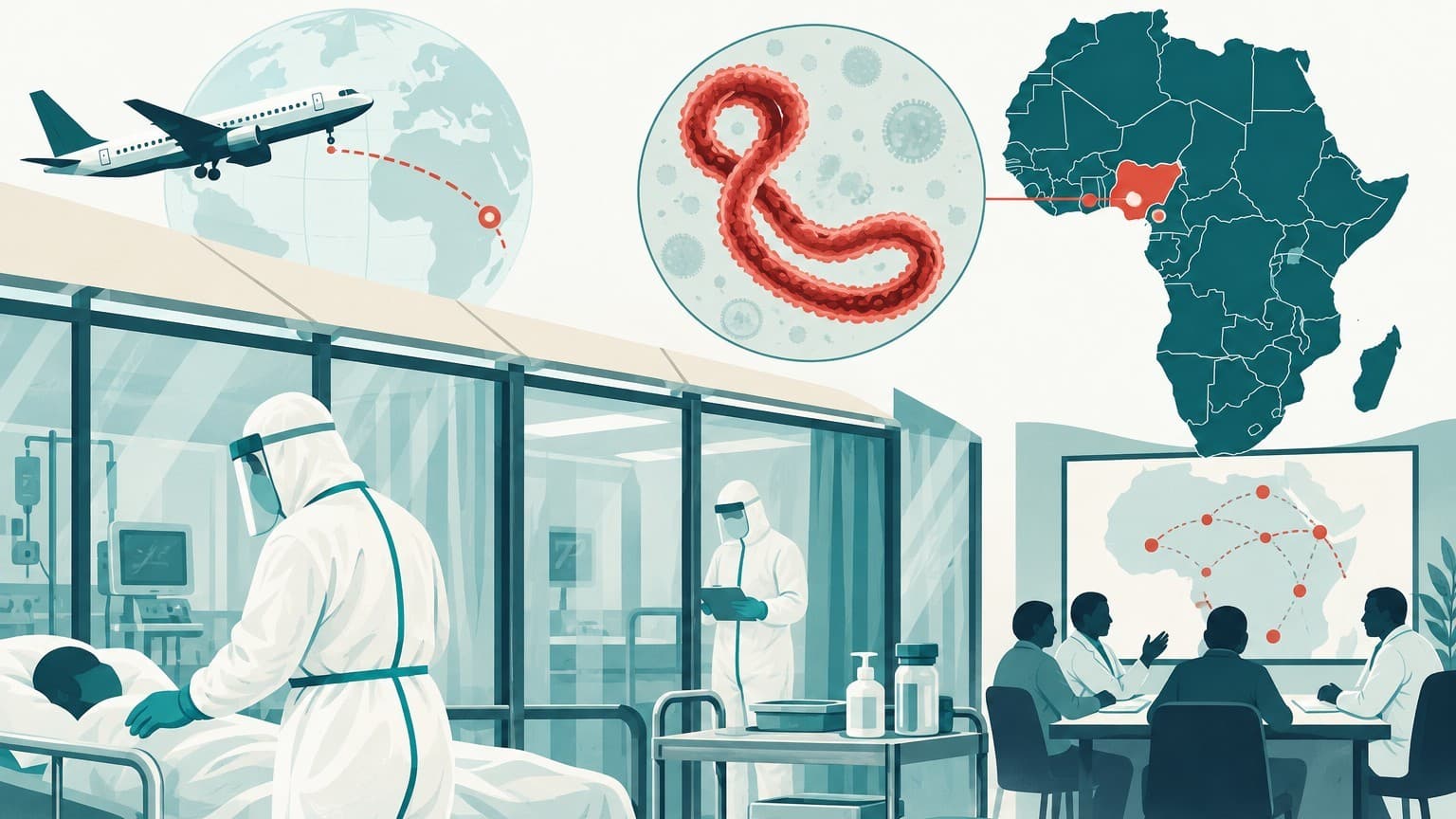
Nigeria confirmed an imported Ebola case in a woman who traveled from Uganda to Abuja, linking West Africa to the outbreak centered in the Democratic Republic of the Congo. The Nigeria Centre for Disease Control and Prevention confirmed the Bundibugyo strain after molecular testing. The woman arrived in Abuja on Oct. 3. Symptoms began Oct. 7, four days after arrival, and she went to a private clinic in Abuja on Oct. 11. Health officials learned she had recently traveled to Uganda and tested her for Ebola on Oct. 19; the positive result was confirmed Tuesday. Health Minister Muhammad Ali Pate said on public broadcaster NTA that the patient is isolated and being treated.
Nigeria has listed 44 contacts, with health workers making up most of them. The list includes her husband, a Swiss citizen residing with her in Abuja. Authorities are also locating other passengers from her Uganda-to-Nigeria journey, though they think she had no symptoms during the flight. Ayoade Alakija, a Nigerian doctor who co-leads a G7 panel on global health investment, noted the woman was sick for 12 days before being tested, possibly exposing many others. An unnamed official told AFP the patient is a diplomat and is now in multi-organ failure.
Olajumoke Babatunde, who directs the public health laboratory service at the NCDC, said officials performed three levels of molecular testing and confirmed the Bundibugyo strain. The WHO also verified the strain, which has no vaccine or specific treatment. The outbreak is caused by the Bundibugyo species of Ebola. Kenya has recorded nine infections linked to an imported case, while the outbreak, the second largest on record, expands. The WHO has called it the fastest-growing Ebola outbreak ever.
Late Wednesday, Africa CDC announced an extraordinary virtual meeting of national health officials on Oct. 28 to strengthen the cross-border response. Director-General Jean Kaseya wrote that Ebola is now affecting three regions of Africa. "Ebola is now affecting three regions of Africa," Kaseya posted, calling for urgent action and political leadership. Since the virus was first confirmed in DRC in May, infections have surpassed 9,500, and close to half of those infected have died. WHO has asked regional countries to remain highly ready while the DRC outbreak changes.
The DRC remains the epicentre, and this outbreak is its deadliest on record. In 2014, the country's first case, found in Lagos, was controlled within three months; that event caused 20 infections and eight deaths. The larger epidemic killed more than 11,000 people in West Africa from late 2013 through 2016.
Update, October 23, 2026
Switzerland's foreign ministry has confirmed the Abuja patient is the 42-year-old Ugandan-born wife of a Swiss diplomat; her husband is isolating without symptoms. The ministry told the BBC all 25 embassy staff are well and do not need to isolate. It said she spent about a week at a private clinic before diagnosis and believes she contracted the virus in Uganda, though the source is not established. The WHO said she is showing signs of improvement.
WHO Africa regional director Mohamed Janabi called the outbreak "more complex" after Nigeria confirmed an imported case. WHO's Nigeria representative Pavel Ursu said she returned to Abuja on Oct. 3 after being in Uganda since Sept. 16; an NCDC emergency meeting heard she flew Ethiopian Airlines and transited through Addis Ababa. Africa CDC Director-General Jean Kaseya told AFP she is originally from Uganda but based in Abuja and did not go to the DRC, against an earlier Ugandan account. The Swiss government told Reuters on Friday that she did not travel to DR Congo.
Investigators are examining whether she crossed paths with a Kenyan man who died from Ebola and passed through Uganda's main airport the same day, possibly through shared equipment, though no link is established. WHO says it is too early to determine where she was infected and the NCDC is prioritising genomic sequencing. Nigerian authorities are tracing more people beyond the 44 contacts initially identified.
Update, October 23, 2026
Nigerian medical groups are calling for nationwide Ebola measures after the first case in about a decade. The Medical and Dental Consultants' Association of Nigeria and the Academy of Medical Sciences of Nigeria urged federal and state governments to activate isolation and treatment centres, strengthen surveillance and contact tracing, and provide PPE for health workers, ABC News reported. Both groups sought screening at airports, seaports and land borders for travellers from affected countries, and MDCAN President Chidi Ndukuba asked for emergency operations centres and point-of-entry screening; AMSN recommended high-alert protocols using lessons from 2014 and COVID-19.
At a Thursday press briefing, Africa CDC reported 9,704 cases and 4,687 confirmed deaths in the DRC, a 48.3% case fatality rate, and said cases have also been reported in France, while none have been reported in the United States and the US risk remains low. Africa CDC's head of emergency preparedness, Wessam Mankoula, said investigators are looking into "some sort of interaction between the two cases at the airport" in Uganda.
Nigeria's health minister, Muhammad Ali Pate, said Thursday that the woman's contacts had been tracked down since her arrival and that an undisclosed number of "high risk" individuals "have been quarantined, fully, in a facility," according to the Japan Times.
Update, October 23, 2026
AP reported on Thursday that the possible crossing under investigation occurred at Uganda's Entebbe International Airport on Oct. 3, and that the current outbreak has become the continent's most geographically widespread Ebola outbreak in history. Africa CDC data cited by AP show only 20% of confirmed cases in the DRC are among known contacts and about 60% of deaths happen in the community, outside treatment centres; the virus has reached eight provinces and 66 health zones in the east. Uganda recorded 20 cases before declaring itself free of Ebola, though AP reported the declaration came in June while the BBC said it has been free since August.
The BBC reported that the Nigerian patient sought care at two private health facilities before her positive test on Oct. 20, and that the Swiss foreign ministry consulted Nigeria's health ministry and the WHO before deciding embassy staff did not need to isolate. It added that the Kenyan man travelled from DR Congo through Uganda to Nairobi on Oct. 3; Kenya's health director-general said all nine confirmed infections are linked to that first patient, with no evidence of wider community transmission, and the eight surviving patients remain isolated and responding to treatment. The BBC also reported that Ugandan health officials had said the woman travelled to eastern DR Congo for business, a claim the WHO, Africa CDC and Nigeria's health ministry said they had not verified. WHO emergency official Patrick Otim said investigators had limited opportunities to interview her while she remained in hospital.
Update, October 24, 2026
Nigeria released ₦10bn ($6.7m) in emergency funding for laboratory testing, personal protective equipment, health worker mobilisation and other containment measures, Health Minister Muhammad Ali Pate told the BBC. Pate said the patient is improving and can now talk, with reduced enzyme levels signalling calmed inflammation, and contact tracing is focused on the two medical facilities she visited before diagnosis. On Friday, Pate and the NCDC head provided an update; Pate said genomic sequencing suggests the Nigerian case is genetically related to a strain identified earlier in Kenya, though there is no evidence the Kenyan patient travelled to Nigeria and further testing is under way. Nigeria has 14 laboratories able to test for Ebola and notified WHO within 24 hours, Pate said. Lagos and Delta states outlined preparedness measures including isolation centre upgrades, airport screening, simulation and health worker retraining. Pate said the imported case is "contained, so far" and there is no evidence of community spread. TVC News reported Nigeria's 2014 outbreak caused 19 infections and seven deaths, and Ebola has killed more than 15,000 people in Africa over 50 years. Ugandan spokesman Alan Kasujja rejected linking Nigeria's case to Uganda as "preposterous".
Update, October 25, 2026
Eye Radio reported that South Sudan's health ministry issued a statement on 15 May urging vigilance and intensified preparedness after Ebola cases in eastern DRC and a fatal imported case in Uganda. The ministry said cross-border movement and trade between affected areas and South Sudan increase the risk of importation.
In Ituri Province, DRC health authorities said preliminary laboratory work confirmed Ebola in 13 of 20 samples, and reported roughly 246 suspected infections and 65 deaths, mainly in the Monwalu and Rwampara health zones. Uganda recently recorded a Bundibugyo Ebola case in a 59-year-old Congolese man who died in Kampala; Ugandan officials said the infection was imported from DRC and that no local transmission had been detected.
South Sudan's ministry said it is collaborating with the National Public Health Institute, WHO and other partners on surveillance, screening and rapid-response work. It urged reporting of symptoms such as sudden fever, fatigue, vomiting, diarrhoea, muscle pain, headache and unexplained bleeding through toll-free hotline 6666, and advised avoiding contact with anyone showing Ebola-like symptoms and regular handwashing. The statement said early detection, prompt reporting and adherence to public health guidance are essential to prevent spread.
Update, October 25, 2026
The Manila Times reported that the outbreak has now reached a fourth African country, Nigeria. It also reported that Kenya's first case was a businessman in his 40s who had lived in the Democratic Republic of the Congo and died in Nairobi on Oct. 5. The newspaper said the man's case was reported on Oct. 6, and the eight later infections were mostly in people with close links to him. At Lagos's international airport, officials screened all inbound international travellers on Friday.
Update, October 25, 2026
At a Thursday Africa CDC briefing, Dr. Wessam Mankoula said the 44 people who had close contact with the Nigerian patient have been quarantined. NPR reported that the patient had been on holiday in Uganda in September before returning to Abuja earlier this month. NPR also reported that Nigeria, though the fourth African country to record a case during the current outbreak, is the first in West Africa and the farthest from the outbreak's centre in the Democratic Republic of the Congo.
Sources
- Nigeria identifies travel-related Ebola case, STAT
- Nigeria’s first Ebola case matches DR Congo strain, health officials say, Al Jazeera
- Africa CDC calls crisis meeting as Ebola spreads to Nigeria, Deutsche Welle
- WHO warns of 'complex' Ebola outbreak in Africa after spread to Nigeria, The Peninsula Qatar
- Ebola in Nigeria: Switzerland confirms case is diplomat's wife, BBC News
- Nigerian medical groups call for nationwide measures after 1st Ebola case, ABC News
- Africa faces ‘complex’ Ebola outbreak after spread to Nigeria, WHO warns, The Japan Times
- First Ebola patients in Nigeria and Kenya might have crossed paths at Uganda airport, ABC News
- Ebola in Nigeria: Switzerland confirms case is diplomat's wife, BBC News
- WHO Warns Of ‘Complex’ Ebola Outbreak In Africa, Trending News
- Ebola case in Nigeria: How Nigerian states dey prepare against possible outbreak of virus as govment release N10bn, BBC News Pidgin
- South Sudan urges vigilance after Ebola outbreaks in DRC, Uganda, Eye Radio - Eye Radio Network
- Africa faces ‘complex’ Ebola outbreak after Nigeria hit, The Manila Times
- Authorities investigating whether first Kenya and Nigeria Ebola cases crossed paths, OPB
Corrections. Report an error to corrections@clinicalobserver.com. Read our corrections policy.